Azo Bladder ControlDoes AZO Bladder Control Work? What the Evidence and Buyer Reports Show
Does AZO Bladder Control Work? What the Evidence and Buyer Reports Show

The short answer
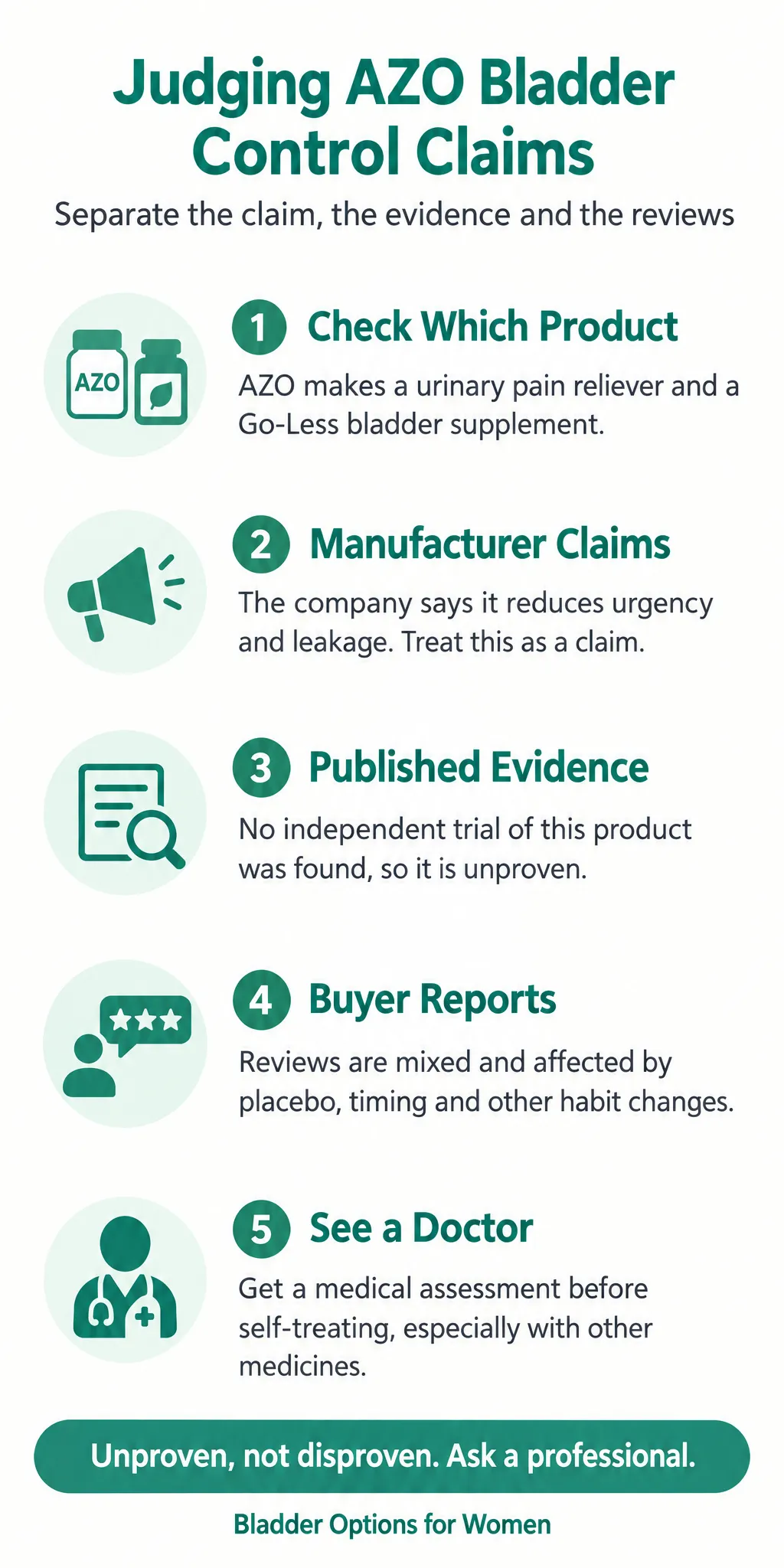
The evidence for AZO Bladder Control is limited. The manufacturer makes claims about reducing urgency and leakage, but independent published trials of this specific product are not widely available. Buyer reports are mixed, with some people describing relief and others noticing no change. Reviews are hard to interpret because symptoms fluctuate, placebo effects are common and the product line covers different formulas. Treat it as an unproven option, not a substitute for medical assessment.
Some links on this site are affiliate links: if you buy through one, the site may earn a commission at no extra cost to you. More about this.
Sudden urges and bathroom trips that interrupt your workday, your sleep and your plans can be exhausting, and it is easy to feel you should be able to manage them alone. Many women would rather try something simple at home than book an appointment first, and that is a reasonable place to start.
If you are looking at AZO Bladder Control, you deserve a straight answer about what it does and does not show. This page separates the manufacturer's claims from published research and from what buyers actually report. It also explains why mixed reviews are so hard to read, so you can judge the product on its merits.
Here is what the article covers:
- Manufacturer claims: what the company says the product does, and how far that goes.
- Published research: what independent studies exist, and what they do not tell you.
- Buyer reports: the common patterns in reviews, and why they conflict.
- Why reviews mislead: symptom swings, placebo effects and mixed formulas.
- When to see a doctor: warning signs that call for an assessment before you self-treat.
What AZO Bladder Control Is and What It Claims
AZO is a brand name that appears on more than one product, so it helps to confirm which one you are looking at before you read any claims. Two products are often confused. The first is a urinary pain reliever, an over-the-counter medicine aimed at discomfort and burning during urination. The second is Go-Less, a daily supplement sold for bladder control. They have different ingredients and different labels, so a review of one tells you little about the other.
Here is how the manufacturer describes the bladder control line. Treat each point as the company's claim, not as something independently verified:
- Helps with urgency and the sudden need to go
- Helps reduce leakage between bathroom trips
- Supports a more comfortable urinary tract
- Is intended for everyday use
When you read the packaging, check the wording closely. Many listings include warnings about use during pregnancy, while nursing, for children, and alongside other medicines. Those warnings matter. If you take prescription drugs or have a health condition, read them in full and ask a pharmacist before you add the product to your cart.
Two AZO products that get confused
| Product | Intended use |
|---|---|
| Urinary pain reliever | Discomfort and burning during urination |
| Go-Less supplement | Bladder control, daily use |
What Published Evidence Exists
Before you spend money, it helps to know what kind of evidence stands behind a product. For AZO Bladder Control, the honest starting point is that the sources reviewed for this page cite no independent clinical trial showing that the product reduces overactive bladder symptoms. That does not prove it fails. It means no published study we could find has tested it in a way that would settle the question.
It helps to separate three things that often get blurred together:
- The manufacturer's claim. This is what the packaging and marketing say the product does. A claim tells you what the seller wants you to believe, not what has been shown.
- A trial in the product's own population. This is a study that tested the actual product in people with the condition it targets, such as adult women with urgency or leakage. This is the strongest kind of evidence for the product itself.
- General evidence about its ingredients. Some ingredients have been studied in other settings or at other doses. That can make a product plausible, but it does not show that the finished product works the way it is sold.
When the middle category is missing, the honest answer is that the effect is unproven, not disproven. Those are different conclusions. "No evidence" does not mean "does nothing," and a claim on the label is not proof.
Buyer reports add a further layer. Reviews can describe real experiences, but they are hard to interpret. People with overactive bladder often improve over time or with other changes at the same moment they start a product. They report what they noticed, not what a controlled test would measure. Mixed reviews are what you would expect from an uncertain product, and they cannot stand in for a trial.
What Buyer Reports Show, and Why They Conflict
Read enough reviews of AZO Bladder Control and you will find nearly every opinion on the spectrum. Some buyers say their urgency eased within a few weeks. Others say they used it for a month and noticed no difference at all. A few describe the opposite, feeling no better or simply giving up. None of that tells you whether the product works for you, because individual reports are not controlled tests.
Several things can make a reviewer feel helped even when the product did little:
- Placebo response. Expecting relief can genuinely change how urgency feels, and that effect is real in many symptom-based conditions.
- Natural fluctuation. Overactive bladder symptoms often rise and fall on their own. If you start a product during a bad stretch, the next stretch may look like an improvement.
- Multiple changes at once. People who start a supplement often also cut back on caffeine, drink less in the evening or pay closer attention to fluids. Any of those changes could be the real cause.
- Different underlying problems. Some reviewers have overactive bladder, others have interstitial cystitis, a urinary tract infection or leakage from pelvic floor weakness. A product aimed at one of these may not touch another.
People who feel helped are also more likely to post a review, while people who saw nothing often stay quiet. That skews the public picture toward success. Use these reports to understand what other women tried, not as evidence that the product will help you. If you want a clearer comparison of the options, the hub guide on overactive bladder treatment covers medicines, over-the-counter products and lifestyle approaches side by side.
What the evidence and buyer reports can and cannot tell you
| Source | What it can show | What it cannot show |
|---|---|---|
| Manufacturer claims | What the seller says the product does | Whether the product works |
| Published trials of the product | Effect in the target population | Not stated |
| Buyer reviews | Real experiences of other users | Cause of any change |
| Ingredient studies | Plausibility of ingredients | Effect of the finished product |
How to Read Reviews Sensibly
Reviews are the easiest evidence to find and the hardest to interpret. A glowing comment and a furious one can describe the same product, often while describing different problems. Before a review shapes your decision, check a few things about the person writing it.
Does their condition match yours?
Overactive bladder, a urinary tract infection and interstitial cystitis all cause urgency, frequent trips to the toilet and discomfort, but they need different treatment. A product that helps someone with an infection will not necessarily help someone with urgency and leakage, and the reverse holds too. If a reviewer does not say what they were treating, their experience tells you less than it appears to.
How long did they use it, and how?
Check whether they took or used the product as the label directs, and for how long. A review written after three days is a first impression. A review written after several weeks of consistent use tells you more. Be wary of people who took larger amounts than recommended, or who stopped and restarted without saying so.
Look for patterns, not single opinions
One enthusiastic review proves very little, and one angry review proves very little either. What matters is whether many unconnected people describe similar results, similar side effects or similar disappointments. When the same detail keeps appearing across dozens of reviews, it deserves more weight than the most dramatic single story.
For a fuller walkthrough of how these patterns show up for this product, see the hub's review-reading page.
How to Test It Fairly and Know When to Stop
If you decide to try a product, the way you test it matters as much as the product itself. Without a clear baseline, it is easy to credit a product for a good week that would have happened anyway, or to give up on it after a bad one.
Before you begin, spend a few days recording what is happening now. Note how often you feel a sudden urge to go, how many times you get up to urinate at night, and whether you leak and in what situations. Track this for at least three days so you have a rough starting point to compare against.
During the trial, keep a short daily diary. It does not need to be elaborate. Jot down:
- Roughly how much you drank, and when
- Caffeine and alcohol, including tea and fizzy drinks
- Urgency, frequency and leakage, using the same scale you used at baseline
- Any side effects, such as dry mouth, constipation or dizziness
Food and fluid patterns often explain more of the day-to-day variation than a supplement does, so the diary also helps you spot those.
Give the product a fair run, and keep your routine steady while you do. Changing your diet, fluids or other medicines partway through makes the results impossible to read.
What if nothing changes?
If your symptoms have not improved after a reasonable trial, stop and talk to your doctor or a pharmacist about other options. Symptoms that do not respond, get worse, or come with blood in the urine, fever or pain need prompt medical assessment. Your diary will make that conversation much more useful.
When to See a Doctor Instead of Self-Treating
Before you buy anything for urinary symptoms, ask whether the cause might be an infection. AZO products are not a treatment for urinary tract infections, and using one to mask an infection can delay the care you actually need. A urinary infection usually needs testing and often a prescription, so the right first step is a doctor or pharmacist, not a product from the cart.
Get medical advice promptly if you notice any of the following:
- Fever, chills or pain in your back or side
- Blood in your urine, or urine that looks cloudy, dark or smells strong
- Burning or pain when you pass urine that is new or getting worse
- Symptoms that appear suddenly or are changing quickly
If your symptoms are steady and not accompanied by these signs, a product may still not be the right first move. Talk to a doctor before use if you take other medicines, have high blood pressure or a kidney condition, or are planning surgery. Some combinations and conditions call for a professional check first.
For the wider picture, read the other pages in this hub on treatment options and side effects, so you can weigh your choices before committing.
What hands-on reviewers found
These are other people's hands-on tests, summarised and credited to them. Watch the full videos for their complete reviews.
Dr. Bri's Vibrant Pelvic Health: Uresta Review for Bladder Leaks and Pelvic Support 💖 Reusable, Over-the-Counter
Dr. Bri thinks Uresta is a practical, reusable, over-the-counter option that gives her mild prolapse support during activity, most comfortable at the smallest size, though it is not designed as a prolapse device and works best combined with
- The reviewer says she feels supported for her very mild prolapse when using Uresta, especially when constipated, though she does not experience bladder leaks. (at 8:23)
- She finds the smallest size, size three, works best for her, and says the sizing range lets users step up or down for more or less support. (at 10:10)
- She prefers Uresta because it is reusable, unlike Poise Impressa, which she says must be thrown away after each use and contains plastic. (at 10:44)
Frequently asked questions
What are some medications that can cause frequent urination?
Several common medicines can increase how often you urinate. Diuretics, often called water pills, are the most frequent cause because they make the kidneys remove more fluid. Some blood pressure drugs, diabetes medicines that raise blood sugar, and certain antidepressants can also contribute. If you notice a change after starting a new medicine, tell your doctor or pharmacist rather than stopping it yourself.
Does AZO help the bladder?
AZO Bladder Control is sold for urinary comfort and bladder support, and its manufacturer makes claims about it. Published clinical research specifically testing that exact product is limited, so its effect is not well established. Buyer reports are mixed and hard to interpret, because bladder symptoms have many causes and often improve on their own. Treat it as an unproven option, not a proven treatment.
What are the potential side effects of mirabegron in elderly patients?
Mirabegron, a prescription overactive bladder medicine, can raise blood pressure and cause headache, dizziness and nausea. Older adults may be more sensitive to these effects and to changes in heart rhythm. Doctors usually check blood pressure and kidney function before and during treatment. Anyone over 65 should discuss dose and monitoring with their prescriber, especially if they take other medicines.
What are some over-the-counter medications for overactive bladder?
Most over-the-counter products sold for bladder control are supplements or urinary-comfort formulas rather than drugs with strong trial evidence. Phenazopyridine is sold over the counter for short-term urinary pain relief, but it treats symptoms, not the overactive bladder itself. Antihistamines and some other OTC drugs can worsen urinary retention. Check the active ingredients with a pharmacist before starting anything.
Should I see a doctor before trying an overactive bladder product?
It is a sensible step, especially if you have blood in your urine, fever, pain, sudden incontinence, or nighttime urination that wakes you several times. You should also check with a clinician if you take blood pressure medicine or diuretics, or have kidney, heart or prostate issues. A short visit can rule out infection or other causes that a supplement would not treat.
Wrapping up
The published evidence for AZO Bladder Control is thin, and buyer reports are mixed and hard to read on their own. If you try it, track your symptoms for a few weeks and check the ingredients against your current medicines. Persistent or worsening symptoms deserve a doctor's assessment before you rely on any product.
Have you tried AZO Bladder Control, or another bladder product? Share what you noticed in the comments.
Visit the official site if you want to read the product details yourself and compare them with the options covered here.